Showing posts with label Carl Sagan. Show all posts

December 15, 2010

Book Review: Billions and Billions

Image: Random House
I have to admit, I originally picked up Billions and Billions because of the title. Seeing it paired with Carl Sagan’s name instantly reminded me of Cosmos and his distinctive way of pronouncing billions. That initial statement and his personal explanation about it provided a wonderful introduction to the book, to what turned out to be an entry into the thoughts and beliefs of Carl Sagan.

What makes Billions and Billions distinctive is that it not only contains Sagan’s views on the cosmos, but other areas and issues about the world as well. Sure, the reader does ultimately learn more about what’s outside our planet through the book, but not without also seeing his views on areas such as climate change and nuclear weapons. Yet, perhaps as only Carl Sagan could, he compares these comparatively small issues with their importance on the grand scale. Never before have I been so deeply motivated to make more progress against climate change than after reading Sagan eloquently explain how we are gradually destroying life on the only place we know to harbor it in the universe.

The last parts of the book were especially moving. As someone viewing his writings from more than a decade past his death, it was somewhat painful to see how many future developments in science and technology he yearned to see, of which, some have since come to fruition, all the while remaining optimistic about humanity. Afterwards, I realized optimism was the one thing binding the book, and its myriad of topics, together. While discussing how humanity will face the problems of climate change or nuclear weapons, he never wavered from his optimism, continuously believing that we possess the necessary will and skill to tackle these future problems.

Billions and Billions: Thoughts on Life and Death at the Brink of the Millennium is a wonderful book for anyone wishing to read thoughtful essays on current issues from a great scientist and astronomer, or even just wishing to learn more about Carl Sagan himself. This book is available at many online bookstores, including Amazon and Random House.

June 27, 2010

The Pale Blue Dot

The Pale Blue Dot
Image: NASA
In 1990, after having completed its primary mission, Voyager 1 received instructions to turn its cameras back around to Earth. NASA had received a request from the famous astronomer Carl Sagan to photograph the Earth from 6 billion kilometers away, as the spacecraft was leaving the Solar System. In the resulting picture (above), Earth appeared to be just a tiny dot hanging in a beam of light in the middle of space, a "pale blue dot."

Carl Sagan's reflections about the picture are especially thought provoking and humbling. His words never fail to make me appreciate the value of humanity and our home planet.
From this distant vantage point, the Earth might not seem of particular interest. But for us, it's different. Consider again that dot. That's here, that's home, that's us. On it everyone you love, everyone you know, everyone you ever heard of, every human being who ever was, lived out their lives. The aggregate of our joy and suffering, thousands of confident religions, ideologies, and economic doctrines, every hunter and forager, every hero and coward, every creator and destroyer of civilization, every king and peasant, every young couple in love, every mother and father, hopeful child, inventor and explorer, every teacher of morals, every corrupt politician, every "superstar," every "supreme leader," every saint and sinner in the history of our species lived there – on a mote of dust suspended in a sunbeam.

The Earth is a very small stage in a vast cosmic arena. Think of the rivers of blood spilled by all those generals and emperors so that, in glory and triumph, they could become the momentary masters of a fraction of a dot. Think of the endless cruelties visited by the inhabitants of one corner of this pixel on the scarcely distinguishable inhabitants of some other corner, how frequent their misunderstandings, how eager they are to kill one another, how fervent their hatreds.

Our posturings, our imagined self-importance, the delusion that we have some privileged position in the Universe, are challenged by this point of pale light. Our planet is a lonely speck in the great enveloping cosmic dark. In our obscurity, in all this vastness, there is no hint that help will come from elsewhere to save us from ourselves.

The Earth is the only world known so far to harbor life. There is nowhere else, at least in the near future, to which our species could migrate. Visit, yes. Settle, not yet. Like it or not, for the moment the Earth is where we make our stand.

It has been said that astronomy is a humbling and character-building experience. There is perhaps no better demonstration of the folly of human conceits than this distant image of our tiny world. To me, it underscores our responsibility to deal more kindly with one another, and to preserve and cherish the pale blue dot, the only home we've ever known.
Carl Sagan later wrote The Pale Blue Dot: A Vision of the Human Future in Space*. Inspired by the photograph, Carl Sagan talked about the human future in space. Recently director Michael Marantz has constructed a wonderful short film based on an excerpt from the book. You can watch it below. (It looks great full screen in HD!)


Update: I found another great video on YouTube. This one is based on the based on the reflection written above.

*The book is available on Amazon, and is a great read. Please note that purchases made on Amazon.com through Amazon links on this blog help support this blog. A small portion of your purchase will automatically be donated towards this blog. You will not be charged extra for your purchase.
December 29, 2009

Solar System Gravity Wells


On Monday (December 28), Randall Munroe released an XKCD comic on gravity wells. It's a funny, but accurate, way to look at and compare the sizes and masses of the bodies in the solar system. So what exactly is a gravity well?

November 16, 2009

Sagan-Man!


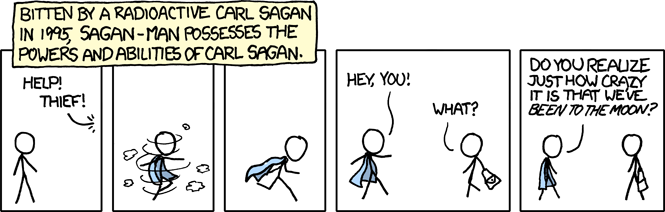
Today's XKCD comic depicts a fictional superhero: Sagan-Man, a crime fighter who uses inspiration about space to conduct his superhero tasks. Carl Sagan was a very famous astronomer, particularly well known by how he popularized astronomy. I myself was very inspired by his TV show, Cosmos, which explained often seemingly mysterious cosmological concepts with wonder, excitement, and always a great deal of curiosity.

However, Carl Sagan passed away in 1996, and there have really been no other highly inspirational astronomers that can completely fulfill his talent of passing down curiosity about our universe to others. Astronomy would benefit greatly from an advocate like Sagan-Man, as the alt text of the comic says, "They laugh now, but within 10 years the city's entire criminal class will have quit to work on space research."

Comic: Randall Munroe, XKCD


Astronomy and Space Celebrates International Year of Astronomy 2009