Showing posts with label Solar System. Show all posts

November 13, 2010

Fly Around the Solar System

Voyager 2 looking back at the planets in Eyes on the Solar System.
NASA’s new beta version of Eyes on the Solar System, developed by the Jet Propulsion Laboratory and Caltech, lets you do just that. The web application is essentially a 3D model of the solar system, containing many of its bodies and a great number of space probes sent out from Earth (including Epoxi 2, which recently performed a flyby of comet Hartley 2). With a number controls, you can zoom around the solar system exploring these objects, with beautiful 3D models for each of them. You can also manipulate the time to explore where the objects and the probes were in the past, or where they will be in the future.

Overall, this is a very glorious and well done project. It’s already a great tool for learning more about our planet's local neighborhood, and as it accumulates even more data and more components of the solar system, it can only get better. I can’t wait until this project leaves beta status, and includes further inclusions like nebulae and galaxies. You can head over to the project site right now to try it out. You will have to install the Unity Web Player plug-in in order to use it, and you will be prompted to install it on the site.

Cassini and Saturn in Eyes on the Solar System
Halley's Comet in Eyes on the Solar System

July 12, 2010

Rosetta's Closeup with Asteroid Lutetia

Asteroid Lutetia, captured by Rosetta
Image: ESA

ESA’s Rosetta mission successfully completed a flyby of asteroid Lutetia on July 10, capturing spectacular images of a remnant from the solar system’s creation. The spacecraft came as close as 3162 km, at a velocity of 15 km/s. At that velocity, the flyby did not last long (about a minute), but the craft was prepared with a variety of sensors to capture data before, during, and after the short flyby. Rosetta hunted for evidence of the presence of an atmosphere and magnetic effects, while studying the composition and density of the rocky body. The spacecraft even tried to capture and analyze grains of dust from the asteroid that may have been kicked into space around the asteroid. The results from these studies will be revealed at a later time.

Probably the most breathtaking of the rich information the Rosetta spacecraft captured from its flyby are the magnificent images of the rocky body. The craters and the surface of the asteroid are revealed in a stunning amount of detail, never before available to us. The images were especially breathtaking for me since I worked on researching asteroids for my high school senior project. Looking at just a tiny dot moving across a computer screen, I could never help but wonder what that tiny dot really is. What does it actually look like and what is it made of? Now looking at any asteroid, at what on Earth would appear as just a small dot indistinguishable from the hundreds of stars on an image, take on a definite and unique shape never ceases to blow me away.

Asteroid Lutetia with Saturn
Image: ESA
My favorite image from Rosetta is the image of asteroid Lutetia captured alongside Saturn. It nicely frames one of the largest bodies in the solar system with one of the smallest.

The Rosetta mission itself was launched in 2004, and is headed towards comet 67P/Churyumov-Gerasimenko, with that encounter scheduled for 2014. It will orbit the comet and deploy a lander, studying its composition which will help us eventually understand more about comets and the early solar system. In fact, Rosetta’s name originates from that of the Rosetta Stone, since it is designed to unlock secrets about the solar system before the existence of planets, much like how the Rosetta Stone unlocked secrets about Egyptian hieroglyphics. Asteroid Lutetia is the second asteroid that the spacecraft has flown by on its way to the comet.

Additional images of Lutetia captured by Rosetta are included below. (Images: ESA)


P.S. This is my blog’s 100th post. Wow.

June 13, 2010

Hayabusa's Rocky Journey Ends with a Spectacular Return

Image of asteroid Itokawa taken by the Hayabusa probe.
JAXA
A Japanese space capsule, released by the Hayabusa asteroid probe, returned successfully to Earth today, with a spectacular, fiery show. The return marks the end of the seven year Hayabusa mission. The mission is returning from a nearby asteroid, named Itokawa, with a capsule perhaps filled with material collected from the asteroid itself. [Video of reentry and full description of mission below the fold.]

December 29, 2009

Solar System Gravity Wells


On Monday (December 28), Randall Munroe released an XKCD comic on gravity wells. It's a funny, but accurate, way to look at and compare the sizes and masses of the bodies in the solar system. So what exactly is a gravity well?

May 31, 2009

A Large Planet Orbiting a Small Star

An artist's conception of the planetary system.

Astrometry, a 50 year old technique used to find exoplanets, planets around other stars, has finally succeeded. Planets outside the solar system are nearly impossible to see, so the method relies on measuring the movements of a star moving back and forth due to its planet. This technique requires numerous careful and precise measurements, and these have to be compared to many others taken over long periods of time. This is why, until now, the method has failed to provide any conclusive evidence towards exoplanets.

Using the Palomar Observatory near San Diego, fitted with an astrometry instrument, a two astronomer team from NASA's Jet Propulsion Laboratory (JPL) have conducted rigorous observations for 12 years. They have studied 30 different stars, and from that number, a new exoplanet has been discovered around one of them.

The planet, VB 10b, is very large and somewhat like the planet Jupiter in our own solar system. It has a mass six times that of Jupiter's, but generates its own internal heat, putting its temperature near the Earth's.

Compared to the planet, its star, VB 10, itself is tiny. It is a twelfth of the mass of the Sun. This is greater than its planet's mass, but the size of the star itself is about the same as its planet. The star used to be the smallest known star, and now is the smallest star known to possess a planet. The importance of the finding is that planets might be very common, even existing around smaller stars like VB 10. "This is a hint that nature likes to form planets, even around stars very different from the sun," states Wesley Traub, chief scientist for NASA's Exoplanet Exploration Program at JPL.

The star's smaller size indicates that it is in the center of a small planetary system. Rocky planets like the Earth would lie between VB 10b and VB 10. The finding indicates that astrometry is capable of finding planetary systems arranged like ours, because it locates planets similar to Jupiter.

In addition to astrometry, other methods of finding exoplanets exist. The radial velocity method analyzes the Doppler shifts in a star's light resulting from a planet tugging on it. The transit method, employed by the Kepler mission, looks at the dips of light that occur when a planet passes in front of its star.

Images: JPL-Caltech/NASA

Astronomy and Space celebrates International Year of Astronomy 2009.

August 9, 2008

Rumble of the Red Spots


You may be familiar with the Great Red Spot, the huge storm brewing in the atmosphere of Jupiter. It is so large, that it can contain two or three Earths within itself! However, you may not know that the Great Red Spot is not alone.

The Red Spots

Three white storms came together to form a bigger storm, called Oval BA, in 2000 on Jupiter. In August 2005, Oval BA started to turn red, and right now is getting more red with time. Because of its color and similarity to the Great Red Spot, this red spot is now being called Red Spot Jr. It has passed by the Great Red Spot now twice. But, it doesn't just end there!

There was also a third red spot on Jupiter, discovered in May, nicknamed Baby Red Spot. However, it has just recently met its demise.

The Death of Baby Red Spot

As shown in the recent (late June/early July) picture of Jupiter by the Hubble Space Telescope above, Baby Red Spot met up with the Great Red Spot. And it was not a happy meeting. The small spot got stuck in the Great Red Spot's anticyclonic (counter-clockwise) spin, and all that came out was a pale and deformed spot. Experts think that this remaining spot will get sucked back into the Great Red Spot again.

What This All Means

The show of power by the Great Red Spot demonstrates its longevity. The recent show of events can tell us why this huge storm on Jupiter has lasted so long. It is known to be at least 178 years old, most likely older, and this was just an example of one of the reasons the Great Red Spot has reached this age.

The animation below of the three pictures taken by the Hubble Space Telescope shows the process by which the Great Red Spot has demolished Baby Red Spot. Also notice Red Spot Jr. passing underneath, unscathed.


Image and Video: NASA

July 3, 2008

Pluto, a Plutoid

Pluto with its moons, Charon, S/2005 P1, and S/2005 P2
Image: NASA/ESA

About two years ago, the International Astronomical Union (IAU) made a big decision. There are going to be eight planets, and Pluto was not one. For Pluto, and also for Ceres and Eris, a new category was created. Pluto, Ceres, and Eris are now considered dwarf planets, a round celestial body orbiting the sun which has not cleared the area around its orbit. In addition,
 dwarf planets cannot be satellites. However, on June 11, the IAU has made another decision.

Pluto is now also considered a plutoid. By the IAU's definition: "Plutoids are celestial bodies in orbit around the Sun at a semimajor axis greater than that of Neptune that have sufficient mass for their self-gravity to overcome rigid body forces so that they assume a hydrostatic equilibrium (near-spherical) shape, and that have not cleared the neighborhood around their orbit." Basically plutoids are dwarf planets that are outside the orbit of Neptune. This currently includes Pluto and Eris, but the IAU expects more planets to become plutoids in the future. There are already numerous objects that are candidates to become plutoids. However, this new categorization has not come without controversy.

The old decision to remove the planet status from Pluto was very cont
roversial, and many believe this new decision is just creating more disagreement. Some think that this is just creating more confusion, by introducing another term in the already big list of existing terms for the same outer solar system objects.
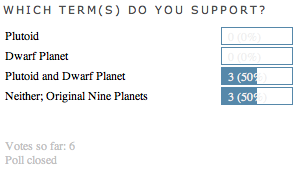
So, I am offering a question to you, the reader. Do you support the plutoid term? Vote on the poll on the sidebar at right. The poll will close on August 1, 2008, so vote now.

Update, Poll Results: With a total of six votes in the poll, three people supported the Plutoid and Dwarf Planet terms, while three other people preferred the original nine planets.

June 30, 2008

"Mission Accomplished, but New Questions Await!"


That's what NASA is announcing about their Cassini mission. Today, on June 30, Cassini is ending its primary mission, lasting for four years. But Cassini is not done with Saturn and its moons. There is still much too left to learn about Saturn, and the primary mission was just the start.

Now, Cassini starts a new journey, with a new two-year mission. This extended mission, called the Cassini Equinox Mission, was approved in April. After Cassini unleashed new information about Saturn's moons Titan and Enceladus, these two moons became the prime targets for te extended mission. The mission will also focus on the seasonal effects on Titan and Saturn, and looking and analyzing the geometry of the rings of Saturn during the Saturn equinox in August 2009, when sunlight will pass directly through the plane of the the rings.

Find out more about Cassini at NASA and JPL.

Image from NASA/JPL.

April 1, 2008

Virgle


Virgle is an April Fool's Joke from Google, like previous ones that they have made, like Google Gulp and Google TiSP. It proposes a "Plan B," carried out over a hundred years, that will aim to colonize the red planet, Mars, by Virgin and Google teaming up. You can even fill out an application to become a "pioneer" in this endeavor, and watch video messages by Larry Page and Sergey Brin, cofounders of Google, and Richard Branson of Virgin. However, it is just an April Fool's joke. But Google points out in one of the pages on the Virgle website, "Virgle isn't real. Yet."

The information on Virgle's website are mostly all based on facts. In fact, if you read the FAQ on the website, you can learn a lot about Mars, terraformation, etc. As Google suggests on an obscure web page stating that Virgle is not real yet, all of this can become reality in the future. Terraforming, as Wikipedia explains, is the process that can make a planet or any other body in space have a similar environment to that of the Earth, to make it habitable for humans. This process is possible and may even take place in the near future. Also, Google suggested a self sustainable base on Mars. This too is also a viable possibility, that may take place as humans look to expand their horizons and settle out of Earth.

So, you can get a good laugh by going to Virgle, but keep in mind, all of this may be reality in the future.

Image from Google.com

The video messages of Larry Page, Sergey Brin, and Richard Branson are posted below:


March 29, 2008

Cassini Meets The Jets of Enceladus


NASA's Cassini spacecraft made a close flyby on Wednesday March 12 of Enceladus, one of Saturn's numerous moons. Cassini flew by the moon at 15 kilometers per second (32,000 mph), through icy water jets, that are similar to geysers. With the information from the flyby, the tiny ice moon Enceladus is revealed to be active and hot. It also has a lot of water vapor and organic material.

There are many fractures running along the moon's south pole, from which the geysers shoot out water vapor at 400 meters per second (800 mph). The geysers added evidence that there may be liquid water under the icy crust of Enceladus.

Also, new heat maps of Enceladus taken by Cassini show higher temperatures in the south pole region, and hot tracks running along the fractures (see image at right). The strips of warmth, also called "tiger stripes," are giant fissures that are the source of the geysers.

The surprising thing about all this news was that the material coming from the inside of Enceladus resembles that of a comet. The Ion and Neutral Mass Spectrometer aboard the Cassini spacecraft saw a combination of volatile gases, water vapor, carbon dioxide, carbon monoxide, and organic materials. It seems that all of these materials are pointing ton one thing: life. However, the final ingredient, liquid water, has not been confirmed yet.

All of these developments may lead to more information about the formation and composition of Saturn and its moons.

For more information:

March 10, 2008

Avalanche!


The High Resolution Imaging Experiment (HiRISE) on NASA's Mars Reconnaissance Orbiter has captured images of enormous clouds of dust and ice rolling down a steep slope (Click on the images at left for a larger view). The pictures were taken on February 19, and have just been recently released by NASA.

The images contain a steep slope more than 700m (2,300 ft.) tall. The location of these pictures had been repeatedly focused upon to check upon seasonal changes, specifically springtime changes in the carbon-dioxide frost covering on a dune. However, these set of images revealed these avalanches. "It really surprised me," said Ingrid Daubar Spitale of the University of Arizona at Tucson. "It's great to see something so dynamic on Mars. A lot of what we see there hasn't changed for millions of years." She was the first person to notice these avalanches on Mars.

NASA does not yet know what has caused these landslides on Mars. They say they will continue to monitor this region to see if these avalanches take place year round, or only in the springtime. A reddish layer rich in liquid water forms the majority of the slope. It is predicted that more ice fell than dust, leading to researchers studying the base of the slope to check its composition showing what part is ice. Researchers also predict that the blocks of ice falling in the avalanche probably turned from solid to gas, and will see if blocks of ice and other debris get smaller suggesting the theory. NASA hopes that the information gained from this will help us understand more about the Martian water cycle.

For more information, visit:

July 18, 2007

The Solar System in Google Earth


The blog barnabu.co.uk has released a Google Earth file to model the solar system. An image overlay over the Earth in Google Earth makes it turn into the sun. 45 scale models of some of the bodies in our solar system.

Download File (7mb)

Note: For a better viewing experience, turn off the atmosphere (View -> Atmosphere). Also, you can jump to different bodies by clicking their names in Places.

If you do not have Google Earth, you can download it at earth.google.com, or you can watch this video:


This file followed another which showcased the moons of the solar system which are greater than 100 km in diameter.

Download File (4.5mb)

Again, if you do not have Google Earth, you can watch this video: