Showing posts with label Ceres. Show all posts

July 30, 2010

Hunting for Ceres in the Pipe Nebula


Ceres is the largest asteroid in the solar system, and is usually bright enough to be visible with telescopes and even binoculars (at around a magnitude of 7). However, unlike the brighter planets, it is not so bright to be able to be distinguishable from the stars that may surround it. Normally to do that would require taking multiple exposures of the field to see which one of the dot moves1, or at the very least, looking at charts giving its position in relation to other stars. However in the month of July, due to its special position, identifying became a lot easier.

In July, Ceres passed in front of Barnard 78 (or the Pipe Nebula), a nebula in the Ophiuchus constellation made up of dark dust and gas. This opportune position allows the nebula to block out background stars which may be confused for the asteroid. Since Ceres is in our solar system, it isn't blocked out, allowing it to be made out easily.

When I observed Ceres on July 20 with my 15x70 binoculars, it took me just a few minutes to identify which dot was Ceres. If you have binoculars or a telescope, definitely try and go outside to see this asteroid. This special position won't last for long!

When hunting for the asteroid, using a chart from a computer is immensely helpful. I used charts from the iPhone/iPad app SkyVoyager and the July issue of Astronomy magazine.

Footnotes

1: Since the Earth rotates, stars rise in the east, move across the sky, and set in the west, just like the Sun. Asteroids (and also planets) also move in their orbits, so in addition to rising and setting, they move across the sky not following the other stars [this is why the name planet comes from the Greek work “wanderer”]. When taking multiple exposures and aligning the stars in the pictures, the one that moves is the asteroid, since it is not following the movement of the stars.

July 3, 2008

Pluto, a Plutoid

Pluto with its moons, Charon, S/2005 P1, and S/2005 P2
Image: NASA/ESA

About two years ago, the International Astronomical Union (IAU) made a big decision. There are going to be eight planets, and Pluto was not one. For Pluto, and also for Ceres and Eris, a new category was created. Pluto, Ceres, and Eris are now considered dwarf planets, a round celestial body orbiting the sun which has not cleared the area around its orbit. In addition,
 dwarf planets cannot be satellites. However, on June 11, the IAU has made another decision.

Pluto is now also considered a plutoid. By the IAU's definition: "Plutoids are celestial bodies in orbit around the Sun at a semimajor axis greater than that of Neptune that have sufficient mass for their self-gravity to overcome rigid body forces so that they assume a hydrostatic equilibrium (near-spherical) shape, and that have not cleared the neighborhood around their orbit." Basically plutoids are dwarf planets that are outside the orbit of Neptune. This currently includes Pluto and Eris, but the IAU expects more planets to become plutoids in the future. There are already numerous objects that are candidates to become plutoids. However, this new categorization has not come without controversy.

The old decision to remove the planet status from Pluto was very cont
roversial, and many believe this new decision is just creating more disagreement. Some think that this is just creating more confusion, by introducing another term in the already big list of existing terms for the same outer solar system objects.
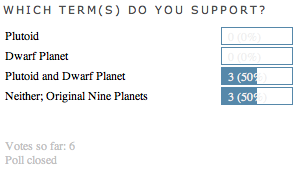
So, I am offering a question to you, the reader. Do you support the plutoid term? Vote on the poll on the sidebar at right. The poll will close on August 1, 2008, so vote now.

Update, Poll Results: With a total of six votes in the poll, three people supported the Plutoid and Dwarf Planet terms, while three other people preferred the original nine planets.