July 7, 2008

Red Stripe in Space

Image: NASA/ESA

So what exactly is that red stripe in the picture? The picture is one of the latest from the Hubble Space Telescope, and the main focus of the image is a red trail of gas. This gas is part of the remnant of a supernova that took place in our galaxy, and lies 6,850 light years away from Earth. So what supernova caused this?

SN 1006 took place in 1006 C.E. (A.D.) between April 30 and May 1. It had the brightest
 apparent magnitude (brightness viewed on Earth) of any stellar event known! The event has been described by many civilizations, particularly the Chinese and the Arabic, which provide us with detailed descriptions of the explosion as it appeared on Earth. Today, this red band is a part of what is left from the mighty supernova. The image on the right shows the shell of the supernova remnant and to what part of the shell the above image belongs to (outlined). Click on the image to view a larger size.

Find out more about:

July 6, 2008

Space Week 2008

Image: Discovery Communications

It's Space Week on the Science Channel again, like last year. It starts today, July 6, at 9 PM E/P on the Science Channel and will last until July 11. Shows celebrating space will be shown during this time on the Science Channel.

July 3, 2008

Pluto, a Plutoid

Pluto with its moons, Charon, S/2005 P1, and S/2005 P2
Image: NASA/ESA

About two years ago, the International Astronomical Union (IAU) made a big decision. There are going to be eight planets, and Pluto was not one. For Pluto, and also for Ceres and Eris, a new category was created. Pluto, Ceres, and Eris are now considered dwarf planets, a round celestial body orbiting the sun which has not cleared the area around its orbit. In addition,
 dwarf planets cannot be satellites. However, on June 11, the IAU has made another decision.

Pluto is now also considered a plutoid. By the IAU's definition: "Plutoids are celestial bodies in orbit around the Sun at a semimajor axis greater than that of Neptune that have sufficient mass for their self-gravity to overcome rigid body forces so that they assume a hydrostatic equilibrium (near-spherical) shape, and that have not cleared the neighborhood around their orbit." Basically plutoids are dwarf planets that are outside the orbit of Neptune. This currently includes Pluto and Eris, but the IAU expects more planets to become plutoids in the future. There are already numerous objects that are candidates to become plutoids. However, this new categorization has not come without controversy.

The old decision to remove the planet status from Pluto was very cont
roversial, and many believe this new decision is just creating more disagreement. Some think that this is just creating more confusion, by introducing another term in the already big list of existing terms for the same outer solar system objects.
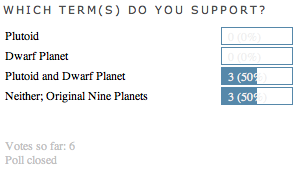
So, I am offering a question to you, the reader. Do you support the plutoid term? Vote on the poll on the sidebar at right. The poll will close on August 1, 2008, so vote now.

Update, Poll Results: With a total of six votes in the poll, three people supported the Plutoid and Dwarf Planet terms, while three other people preferred the original nine planets.

June 30, 2008

"Mission Accomplished, but New Questions Await!"


That's what NASA is announcing about their Cassini mission. Today, on June 30, Cassini is ending its primary mission, lasting for four years. But Cassini is not done with Saturn and its moons. There is still much too left to learn about Saturn, and the primary mission was just the start.

Now, Cassini starts a new journey, with a new two-year mission. This extended mission, called the Cassini Equinox Mission, was approved in April. After Cassini unleashed new information about Saturn's moons Titan and Enceladus, these two moons became the prime targets for te extended mission. The mission will also focus on the seasonal effects on Titan and Saturn, and looking and analyzing the geometry of the rings of Saturn during the Saturn equinox in August 2009, when sunlight will pass directly through the plane of the the rings.

Find out more about Cassini at NASA and JPL.

Image from NASA/JPL.

June 23, 2008

Phoenix's Microscope Receives First Sample


After 28 Sols, or Martian days, the latest images beamed back to NASA from Phoenix, like the one above, show that the lander is continuing to do its job successfully on Mars. Phoenix's robotic arm, in the picture on the top right corner, has just recently picked up a small amount of soil from the Martian ground. Very carefully and gently, the arm sprinkled some of this soil onto the delivery port of the Optical Microscope which is fitted on the Phoenix lander.

The robotic arm is right now in an up position to hold the remaining soil. This soil may be later delivered to the Wet Chemistry Lab or the Thermal and Evolved Gas Analyzer. The researchers want the same type of soil sample to be delivered to all three instruments and analyzed so the findings from each instrument can be compared with those of the others.

Image from NASA.

June 20, 2008

Phoenix Discovers Ice

The animation at right displays the finding of ice on Mars by Phoenix. As the previous posts about Phoenix on this blog show, Phoenix's mission was to find water on the polar regions of Mars, and it has done exactly that.

Through digging, it uncovered bright chunks. These were originally thought to be either ice or salt. However, when Phoenix checked the same location a few days later, it discovered that many of the dice sized chunks were missing. Salt definitely does not do this! This is very solid evidence for these white chunks to be ice, which probably soon after sublimed over the course of four Martian days. The animation shows the change over the four days.

Image from NASA.