Showing posts with label planet. Show all posts

November 26, 2010

An Intriguing Planet From Outside the Galaxy

An artist's impression of HIP 13044 and the planet HIP 13044 b.
Image: ESO/L. Calçada

Recently, exoplanets1 have been discovered at an extremely rapid pace. In just about two decades, astronomers have found and confirmed over 500 planets, with many more waiting to be confirmed. Despite the large number, we're still finding a great amount of new things to be excited about in many of these discoveries.

The telescope used to make the discovery.
Image: ESO/H. H. Heyer
A newly announced exoplanet can claim to be the first one discovered to have originated outside our galaxy. Discovered by the Max Planck Institute in Germany using a 2.2m telescope at the European Southern Observatory in Chile, the planet, HIP 13044 b, orbits around a star, HIP 13044, that is located in the Helmi stream about 2,000 light years from the Sun. This particular group of stars originated from a small satellite galaxy of the Milky Way. The galaxy was later absorbed by the Milky Way about six to nine billion years ago, and gravitational tidal forces subsequently tore it apart and stretched it into a stream of stars. Both the star and planet orbiting around it were likely swept along for the ride.

This particular planet was discovered by the “wobble” method, just as many other exoplanets have been discovered in the past. The host star is studied for a long period of time, and a wobble, found for this star by a doppler shift, indicates a planet gravitationally tugging back on the star as it orbits around. The wobble in this particular case suggests a giant massive planet (similar to Jupiter) orbiting very closely to the star. This is very surprising, since the host star has also already passed through its red giant phase. When a Sun-like star enters the red giant phase, it grows extremely large, increasing its radius by ten to even hundreds of times larger that its original radius. Our Sun is expected to have a radius extending beyond the Earth's orbit when it becomes a red giant in around five billion years. However HIP 13044 b lies very close to its star, inside the area that was likely taken up by the star's red giant size before. This is likely due to the planet migrating inwards from a larger original orbit after the star shrunk, which is very intriguing. Later, the host star is expected to become an asymptotic giant branch2 star, and the discoverers of the planet believe it will be devoured by the star at that time.

Furthermore, this exoplanet's host star is very metal-poor, meaning that it does not have many elements heavier than helium. Other exoplanets discovered so far, on the other hand, have had host stars that are at least as metallic as the Sun. HIP 13044, like the other stars in the Helmi stream, has metal content of about 1% of that of the Sun, in a mass that is about equal to the Sun's. This is just simply not a curiosity, but a potential reconsideration of how planets are formed. In the widely accepted core-accretion planet formation model, the matter around a star gradually coalesces to form planets. However, this model requires heavier elements to begin the process of planet formation, by forming the rocky core first. Without a rocky core, a gas giant, like this particular exoplanet, could not be formed since there is not enough mass to retain the gas. There is an alternative model for the formation of giant planets, called the disk instability , where a giant disk of gas around a star breaks off into planet-sized self-gravitating pieces. These pieces eventually each result in a giant planet. The model may be relevant in this case and this exoplanet discovery may provide substantial evidence for the disk instability model, or perhaps may lead to another future model.

HIP 13044 b's discovery continues to show that although exoplanet discoveries may no longer by novel in and of themselves, they still bring forth fresh considerations and interesting ideas.

Footnotes:

1: Short for extrasolar planets, which are planets located outside our solar system. ↵
2: In order to explain the asymptotic giant branch, I should explain the Hertzsprung-Russell (H-R) diagram first. The H-R diagram is essentially a scatter graph of stars plotted by their temperatures and luminosities (some use other related classifications like absolute magnitude, spectral types, etc.). Most stars in the H-R diagram lie on an area that looks like a curved line called the main sequence. There are also some branches that come out of the main sequence. The asymptotic giant branch is one of these branches, and consists of low to intermediate mass stars (about 0.6 to 10 times the mass of the Sun) in the late part of their stellar evolution. ↵

July 26, 2010

A Planet with a Tail

An artist's interpretation of how extrasolar planet HD 209458b may look.
Image: NASA, ESA, and G. Bacon (STScL)

A giant gas extrasolar planet, HD 209458b, has recently been confirmed to possess a tail, resembling something like that of a comet. The planet is similar to Jupiter, but unlike Jupiter it orbits very close to its star, completing an orbit every 3.5 days1.

The planet, about 153 light-years from Earth, has been heavily studied since its initial discovery because it was one of the first discoveries of an extrasolar planet transiting its star. This is a special case where the orbit of the planet allows it to eclipse its star, as seen from the Earth. The rare position essentially allows astronomers to study the atmosphere of the planet, finding out what chemicals make it up (the process is detailed for a similar case here). Astronomers studying HD 209458b discovered that the planet’s atmosphere contains heavy elements including carbon and silicon. Since the atmosphere is exposed to the scorching heat of the star due to their close proximity, the heavy elements can escape.

Eventually, these materials come together to form a large flow of gas coming out from the planet. On the Earth, astronomers have detected the gas to be coming towards us at 22,000 miles per hour. When the stellar wind from the star picks up the gas, the tail, resembling one of a comet’s, is formed. Still, despite the large outflow of gas, the planet is not likely to completely “evaporate” anytime soon. It is estimated that it will take a trillion years for that to happen.

The recent finding is important in that it further helps us realize how our star is not unique in harboring planets, as the numerous other discoveries of extrasolar planets have proved. However, perhaps more importantly, it shows the intense variety of what can be found in the universe.

Footnotes

1: Extrasolar planets are planets that are found outside of our solar system, orbiting other planets. Recently, there has been an explosion in the discovery of extrasolar planets, and the number of total extrasolar planets discovered so far is currently a little over 450.

December 20, 2009

A Nearby Watery Planet

A new rocky planet, GJ 1214b, has been found very close to the solar system, one of a few hundred exoplanets currently known. Making this discovery special, though, is that the planet contains water, being almost completely covered by it, and that its mass is just a little bit greater than the Earth's.


May 31, 2009

A Large Planet Orbiting a Small Star

An artist's conception of the planetary system.

Astrometry, a 50 year old technique used to find exoplanets, planets around other stars, has finally succeeded. Planets outside the solar system are nearly impossible to see, so the method relies on measuring the movements of a star moving back and forth due to its planet. This technique requires numerous careful and precise measurements, and these have to be compared to many others taken over long periods of time. This is why, until now, the method has failed to provide any conclusive evidence towards exoplanets.

Using the Palomar Observatory near San Diego, fitted with an astrometry instrument, a two astronomer team from NASA's Jet Propulsion Laboratory (JPL) have conducted rigorous observations for 12 years. They have studied 30 different stars, and from that number, a new exoplanet has been discovered around one of them.

The planet, VB 10b, is very large and somewhat like the planet Jupiter in our own solar system. It has a mass six times that of Jupiter's, but generates its own internal heat, putting its temperature near the Earth's.

Compared to the planet, its star, VB 10, itself is tiny. It is a twelfth of the mass of the Sun. This is greater than its planet's mass, but the size of the star itself is about the same as its planet. The star used to be the smallest known star, and now is the smallest star known to possess a planet. The importance of the finding is that planets might be very common, even existing around smaller stars like VB 10. "This is a hint that nature likes to form planets, even around stars very different from the sun," states Wesley Traub, chief scientist for NASA's Exoplanet Exploration Program at JPL.

The star's smaller size indicates that it is in the center of a small planetary system. Rocky planets like the Earth would lie between VB 10b and VB 10. The finding indicates that astrometry is capable of finding planetary systems arranged like ours, because it locates planets similar to Jupiter.

In addition to astrometry, other methods of finding exoplanets exist. The radial velocity method analyzes the Doppler shifts in a star's light resulting from a planet tugging on it. The transit method, employed by the Kepler mission, looks at the dips of light that occur when a planet passes in front of its star.

Images: JPL-Caltech/NASA

Astronomy and Space celebrates International Year of Astronomy 2009.

March 6, 2009

Kepler: Finding Earth-Size and Smaller Extrasolar Planets


Tonight, March 6, a Delta II rocket lifted off from the launch pad at NASA's Cape Canaveral Air Force Station in Florida, United States. Onboard is a very special payload, Kepler. Kepler's mission is to try to reach the ages old goal of trying to find something somewhere else in the universe like us. Right now, we know about many extrasolar planets, planets outside our solar system, but most of these are gas giants or very hot planets. What we want to find more of, however, is planets like our own Earth. We are seeking terrestrial planets, about one-half to twice the size of the Earth, located at an ideal distance away from the star so that liquid water can exist on the surface of the planet. And the Kepler Instrument is made specifically to tackle this monumental challenge. Its challenge is to survey our region of the Milky Way galaxy (right) to search for exactly these planets, and find out how common they are in our galaxy.

Transit Method

Kepler utilizes the transit method to extract information about a specific planet. During a transit, when a planet passes in front of its star as appearing on Earth, there is a tiny drop in brightness. Kepler uses this to find planets. It can then calculate the orbital size from the period of the planet (the amount of time it takes to orbit the star) and the mass of the star, by using Kepler's Third Law of planetary motion.

The amount of brightness a star drops by during the transit, called the depth of the transit, can give additional information. Since the size of the star is known, the planet's size can then be found by using its orbital size and the temperature of the star.

All of this information is not merely trivia. These can tell a lot about a planet, and ultimately give a strong indicator about whether or not the planet is able to support life as we know it. And this process is carried out for thousands of stars throughout the mission. All of these tasks may seem hard for just one telescope, but Kepler is completely prepared.

The Kepler Instrument

The Kepler Instrument (left) is built to confront the numerous jobs given to it. It is a 0.95-meter (about 3 feet) diameter telescope called a photometer or light meter. This telescope has a large field of view, 105 square degrees, meaning it is able to view a large portion of the sky at once (right). The Kepler Instrument will continuously analyze this same field and simultaneously handle the brightness of 100,000+ stars throughout the entire 3.5 year mission. Since the telescope is in space, it can avoid the loss of precision, that can happen easily on Earth, necessary to conduct this important research.

The Kepler Mission may lead us to find out many planets very similar to ours, and will help get us closer
to finding the answer to where life may exist in the universe.

Images: NASA


Astronomy and Space celebrates International Year of Astronomy 2009.

February 28, 2009

Mars in Google Earth

The name Google Earth is increasingly becoming a misnomer. Google Earth has included ways to visualize more than just the Earth, as I have previously talked about the Google Sky feature. But with the recent introduction of Google Earth 5, the software now includes the planet Mars as well.

With the addition of surface imagery and terrain of Mars, Google was able to effectively create a very accurate 3D representation of Mars. To turn on the new Mars feature in Google Earth, just look for the space icon (left), and select Mars from the drop down menu. Flying around Mars is just as easy as it was zooming around Earth before. And just as Google Earth includes placemarks all over the Earth to provide interesting information about special locations, the Mars view does the same (right). Through these, you can find out about imager and the magnificent places on the red planet.

Plus, Google Earth 5 gives you the ability to talk to a real Martian through a hidden easter egg in Google Earth! Well, not really. Although this feature is just a computer program simulating talking, it is a fun addition to this big and valuable update to Google Earth. Just type "Meliza" into the search box, and look for the "MELIZA placemark with an icon looking like a robot.

Google Earth 5 does not just include Mars. With this update, the program now gives the ability to dive through the Earth's oceans and look at old satellite photographs. But I feel that both of these can't match up with the addition of a new planet!

You can download Google Earth 5 here.

Astronomy and Space celebrates International Year of Astronomy 2009.

December 18, 2008

Carbon Dioxide on Extrasolar Planet

Artist's View of the Extrasolar Planet HD 189733b orbiting the star HD 189733

Just a short while ago, the Hubble Space Telescope took the first visible-light photograph of an extrasolar planet, a planet outside our solar system. Now just recently, the space telescope has been used to find the presence of carbon dioxide on an extrasolar planet.

The planet, called HD 189733b, orbiting the star HD 189733, is about the size of Jupiter, and the presence of carbon dioxide on the planet does not prove anything about the presence of extraterrestrial life on there. In fact, the planet is too hot to support life. However, the significance of this discovery was not actually what the telescope found, but the process used to find it.

The process used through the Hubble Space Telescope was used to identify not only carbon dioxide on the planet, but also carbon monoxide, and methane. Just being able to detect, measure, and estimate the amount of something like carbon dioxide on an extrasolar planet is remarkable. This may lay the groundwork for classifying planets by their makeup and potentially looking for signs of life.

This technique (detailed in the picture at right, click for larger view) requires a planet with an orbit tilted towards the Earth edge-on. While orbiting their stars, these planets appear to us to pass in front of their stars, and then go behind the star, a phenomena called an eclipse. When the planet is blocked, only the star's light reaches the Earth. The light emission of the star can be analyzed to tell the chemical composition of the star. This light emission of the star can be analyzed to tell the chemical composition of the star. This light emission is then compared to one taken just before the eclipse, when both the star and the planet's light emissions can be viewed, revealing the chemical compositions of both objects. Since the chemical composition of the star is already known from the star's light emission taken before, this can simply be "subtracted" from the new emission, revealing just the chemical composition of the planet being studied.

Astronomers are also hoping to use similar techniques on NASA's James Webb Space Telescope, after its launch in 2013. This telescope's ability to view near-infrared wavelengths will allow it to better look for biomarkers on a terrestrial planet.

Images: NASA

November 15, 2008

Hubble Takes First Image of an Extrasolar Planet

An artist's concept of Fomalhaut b

The image on the left is the first visible-light photograph of a planet orbiting another star, an extrasolar planet. It was taken by the Hubble Space Telescope. The planet, named Fomalhaut b, orbits the star Fomalhaut. Fomalhaut b is about three times the mass of Jupiter, is located 25 light-years away, and is estimated to be 100 million years old.

The first evidence for the planet came in 2004, when an earlier image by the Hubble Space Telescope of Fomalhaut revealed a ring of protoplanetary debris, having a defined inner edge, very similar to the Kuiper Belt around the solar system. In 2005, a team at the University of California at Berkeley proposed that this ring of debris was being affected gravitationally by a planet in between the star and inner edge of the ring.

The Hubble Space Telescope has now photographed a point of light believed to be the planet Fomalhaut b in that debris. The point lies 1.8 billion miles inside the inner edge of the ring.

Even though the object photographed is a billion times fainter than the star Fomalhaut, it is still brighter than what is expected from a planet three times the size of Jupiter. A possible explanation for this is that the planet has a ring of ice and dust orbiting it reflecting light, like Saturn does, which may later coalesce to form moons.

By comparing images from 2004 and 2006, the team was able to calculate the orbital period of the object. Using Kepler's laws of planetary motion, this came out to an 872-year-long orbit.

Further observations of the planet will reveal more information about the planet, such as a more accurate mass.

For more information, visit:


Images: NASA

September 20, 2008

Another Extrasolar Planet


The picture above is the first picture of a planet (top-left) orbiting a sun-like star. It was taken by the 270-inch diameter Gemini North Telescope, located on Mauna Kea in Hawaii.

The star, 
1RXS J160929.1-210524, is located in the Scorpius constellation, 500 light-years away from Earth. This star is very similar to our Sun, but is younger.

However, more interesting is the planet that is orbiting that star. This planet has a mass 7 to 12 times larger than Jupiter, the largest planet in our solar system. It also lies 30 billion miles (48 million km) away from the star, 330 times the distance from the Earth to the Sun.

Yet, the importance of this discovery is not just in the comparison of this system to our own system. It is only the third candidate planet outside our solar system that has been photographed by us. The astronomers who have made this discovery are checking if the planet is moving with its star through space, confirming that is an actual planet. This may take many years.

Image: Gemini Observatory

August 9, 2008

Rumble of the Red Spots


You may be familiar with the Great Red Spot, the huge storm brewing in the atmosphere of Jupiter. It is so large, that it can contain two or three Earths within itself! However, you may not know that the Great Red Spot is not alone.

The Red Spots

Three white storms came together to form a bigger storm, called Oval BA, in 2000 on Jupiter. In August 2005, Oval BA started to turn red, and right now is getting more red with time. Because of its color and similarity to the Great Red Spot, this red spot is now being called Red Spot Jr. It has passed by the Great Red Spot now twice. But, it doesn't just end there!

There was also a third red spot on Jupiter, discovered in May, nicknamed Baby Red Spot. However, it has just recently met its demise.

The Death of Baby Red Spot

As shown in the recent (late June/early July) picture of Jupiter by the Hubble Space Telescope above, Baby Red Spot met up with the Great Red Spot. And it was not a happy meeting. The small spot got stuck in the Great Red Spot's anticyclonic (counter-clockwise) spin, and all that came out was a pale and deformed spot. Experts think that this remaining spot will get sucked back into the Great Red Spot again.

What This All Means

The show of power by the Great Red Spot demonstrates its longevity. The recent show of events can tell us why this huge storm on Jupiter has lasted so long. It is known to be at least 178 years old, most likely older, and this was just an example of one of the reasons the Great Red Spot has reached this age.

The animation below of the three pictures taken by the Hubble Space Telescope shows the process by which the Great Red Spot has demolished Baby Red Spot. Also notice Red Spot Jr. passing underneath, unscathed.


Image and Video: NASA

July 3, 2008

Pluto, a Plutoid

Pluto with its moons, Charon, S/2005 P1, and S/2005 P2
Image: NASA/ESA

About two years ago, the International Astronomical Union (IAU) made a big decision. There are going to be eight planets, and Pluto was not one. For Pluto, and also for Ceres and Eris, a new category was created. Pluto, Ceres, and Eris are now considered dwarf planets, a round celestial body orbiting the sun which has not cleared the area around its orbit. In addition,
 dwarf planets cannot be satellites. However, on June 11, the IAU has made another decision.

Pluto is now also considered a plutoid. By the IAU's definition: "Plutoids are celestial bodies in orbit around the Sun at a semimajor axis greater than that of Neptune that have sufficient mass for their self-gravity to overcome rigid body forces so that they assume a hydrostatic equilibrium (near-spherical) shape, and that have not cleared the neighborhood around their orbit." Basically plutoids are dwarf planets that are outside the orbit of Neptune. This currently includes Pluto and Eris, but the IAU expects more planets to become plutoids in the future. There are already numerous objects that are candidates to become plutoids. However, this new categorization has not come without controversy.

The old decision to remove the planet status from Pluto was very cont
roversial, and many believe this new decision is just creating more disagreement. Some think that this is just creating more confusion, by introducing another term in the already big list of existing terms for the same outer solar system objects.
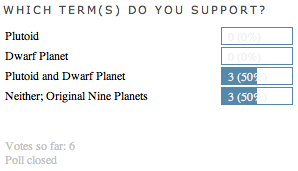
So, I am offering a question to you, the reader. Do you support the plutoid term? Vote on the poll on the sidebar at right. The poll will close on August 1, 2008, so vote now.

Update, Poll Results: With a total of six votes in the poll, three people supported the Plutoid and Dwarf Planet terms, while three other people preferred the original nine planets.

June 30, 2008

"Mission Accomplished, but New Questions Await!"


That's what NASA is announcing about their Cassini mission. Today, on June 30, Cassini is ending its primary mission, lasting for four years. But Cassini is not done with Saturn and its moons. There is still much too left to learn about Saturn, and the primary mission was just the start.

Now, Cassini starts a new journey, with a new two-year mission. This extended mission, called the Cassini Equinox Mission, was approved in April. After Cassini unleashed new information about Saturn's moons Titan and Enceladus, these two moons became the prime targets for te extended mission. The mission will also focus on the seasonal effects on Titan and Saturn, and looking and analyzing the geometry of the rings of Saturn during the Saturn equinox in August 2009, when sunlight will pass directly through the plane of the the rings.

Find out more about Cassini at NASA and JPL.

Image from NASA/JPL.

April 18, 2007

Planets Like Binary Stars, Too

In our solar system, planets, comets, asteroids, and dwarf-planets all orbit around a single star, our Sun. But imagine if we could witness two Suns in our sky. NASA's Spitzer Space Telescope has helped astronomers see that planetary systems are at least as common around double-stars. These binary stars make up more than half of all the stars that we know of, and this conclusion is suggesting that planets may be more common than we previously thought of them.

Astronomers knew that planets could form in binary star systems, where the two stars were really wide apart, about 1000 AU (remember that one Astronomical Unit (AU) is equal to the distance from the Earth to the Sun). The planets that we have found that exist in this situation, number to about 50, and they orbit one of these stars in the system.

This new information, however, focuses on binary stars that are much closer together, between 0 and 500 AU. The question the astronomers were asking was whether the fact that the two stars are so close together affects how the planets grow. To seek the answer to this question, the astronomers had to develop a new technique to hunt for planets. Astronomers use the Spitzer Space Telescope's infrared cameras to look for debris disks, not planets, which are leftover pieces of rock that could not form into rocky planets. This can prove that planet building has occurred in the binary star system, with planets orbiting one, or maybe even two, of the stars in the system.

When these astronomers surveyed binary stars between 50 and 200 light-years from Earth, about 40 percent of them had disks. This number is a little higher than that of single stars. The number gets higher (about 60 percent) for binary stars that are closer together. These stars are only about 0 to 3 AU apart. However, stars between 3 to 50 AU do not harbor as many disks, suggesting that binary stars either have to be either very far apart or really close together to contain planets.

For more information:

December 27, 2006

COROT

COROT or COnvection ROtation and planetary Transits has launched today at Baikonur Cosmodrome in Kazakhstan. It is a project of the French national space agency. It's two and a half year mission will find extrasolar planet, or a planet that does not orbit our Sun, by measuring the dip in the light of the star they orbit as they pass in front of it. A 27 cm (10.6 inch) diameter lens will take in these measurements. COROT is also made to observe "starquakes" (defined by SPACE.com as "acoustical waves generated deep inside stars which ripple across a star’s surface, altering its brightness"). This will reveal properties about the stars that COROT will observe.

For more information: