Showing posts with label life. Show all posts

February 19, 2011

Kepler: An Evolution and a Shift

The announcement by Kepler a little more than two weeks ago was undoubtedly huge. The discovery and confirmation of a really interesting planetary system consisting of six confirmed planets was released. This announcement was coupled with the discovery of over 1200 other planet candidates. In the time since the announcement, I have been struggling to fully comprehend the immense size of the numbers. Now, I have started to just realize that the numbers may not be the most interesting idea to keep in mind. We also have to step back from the recent news and see that the Kepler announcement may be the representation of the start of a new era and a giant shift in looking for life outside of the Earth.

At one level this Kepler announcement represents the evolution of our exoplanet detecting skills, and the number of planets discovered does tell a huge story. The rapid pace we have achieved in detecting exoplanets is no small feat. About 15 years ago, the first extrasolar planets, about the size of Jupiter, were just beginning to be detected. Before these discoveries, many scientists doubted ever being able to detect an extrasolar planet. Now, including great contributions being made by the Kepler spacecraft, we may have about 1500 planets detected and confirmed soon, a remarkable jump especially since many of these planets are much smaller than Jupiter. The Kepler announcement is also encouraging in that its discoveries are only being made in a single patch of sky. This area covers only about 1/400 of the area of the entire sky. Admittedly, other patches of the sky may not be as rich of stars containing planets as Kepler’s field of view, but it is extremely likely a huge amount of planets are still waiting to be discovered.

What really excites me though is that this announcement marks a shift in our search for extraterrestrial life. Although Kepler’s mission is to look for planets and not life, I feel that  the scientific community and the rest of society is particularly interested in exoplanets because they may offer clues as to whether Earth life is an anomaly or the norm. This is why in every news piece I have read about the announcement so far, the fact about the list of potential Kepler candidates containing 54 planets about the size of the Earth located in the habitable zone is particularly emphasized. Any of these planets could contain life that is similar to ours and therefore their discovery captures our attention. The Kepler mission in particular represents a new era, in which our search for life outside our solar system is passing from a passive approach to a more active approach. In the era before Kepler, finding life outside of the solar system meant relying on projects such as SETI (Search for ExtraTerrestrial Intelligence). SETI attempts to detect signals that intelligent life may be broadcasting. This relies on the lifeforms having evolved and progressed as a society far enough so that they are able to regularly broadcast signals in the specific frequency ranges that Kepler is able to detect. Kepler, on the other hand, is taking a more active role. Kepler actually searches for planets that may be hospitable to life. Afterwards these planets can be examined in detail for traces of life, which do not necessarily have to be left behind by intelligent life.

The change, I think, is extremely important. Our search for life has become much more efficient and likely more fruitful. It as if we no longer have to face an expansive ocean hoping intensely that something in it will make contact with us. We can now wade in, start turning over rocks, and examine what we find. This is why I have been very obsessed and excited about the announcement. I believe when looking back after a number of years, the Kepler project and announcements like this will mark the point in history when we no longer sat back, but stood up and got our feet wet.

October 4, 2010

New Exoplanet Could Be First Hospitable to Life

An artist’s rendition of Gliese 581g.
Image: Copyright Lynette Cook
The first Earth-like exoplanet (a planet outside our Solar System has been discovered orbiting in a star’s habitable zone, a range of distances around a planet in which an Earth-like planet can keep and maintain liquid water. Essentially, this could mean that the planet may be hospitable to Earth-like life. The range is often referred to as the “Goldilocks zone” in that it is neither too hot nor too cold for life.

The existence of the planet, Gliese 581g, was recently announced by a team of astronomers from the University of California, Santa Cruz and the Carnegie Institute of Washington. The discovery used date from observations having been collected for over a decade at the Keck Observatory in Hawaii.

The Planet and Consequences for Life

Gliese 581g is one of two planets that was recently discovered orbiting Gliese 58, bringing the the total known planets orbiting the star to six. The star itself is located about 20 light years away from the Earth, and some of its other planets, lying on the edge of the habitable zone, have also been debated to be capable of harboring life. However, life on these planets would likely only be possible if these other planets had certain specific conditions, such as a very thick atmosphere in one case to result in a greenhouse effect that would sufficiently warm up the planet.

On the other hand, Gliese 581g lies very comfortably in the habitable zone. The planet itself is about three to four times the mass of the Earth. This mass likely means that the planet has a definite and rocky surface, and with enough gravity to hold on to an atmosphere. If its density is close to that of the Earth’s, the planet’s radius would be 1.2 to 1.4 times the size of the Earth’s. The gravity on the surface, therefore, would be similar to or slightly higher than on Earth.

Astronomers are estimating that the distance of Gliese 581g from its star is about 0.15 AU (1 AU is the distance from the Earth to the Sun), meaning that it can orbit around its star in a little less than 37 days. In our Solar System, this orbit would be even smaller than Mercury’s, and would make the planet severely hot. However, its star, Gliese 581, is classified as a red dwarf star, making it much cooler than our star, and at this radius, the average surface temperature on the planet is estimated to be between -31 to -12 °C.

This may be surprising in that this temperature is well below freezing, and likely not conducive to life as we know it. However, astronomers have been able to deduce that the planet is also tidally locked to the star. This means that there is one side continually facing the star while the opposing side is continually facing away from the star, just like how the Moon orbits the Earth (we only see one side of the Moon from the Earth). The consequence of this is that one side of Gliese 581g is in perpetual daylight and likely with a very high surface temperature. Meanwhile, the opposing side experiences the opposite treatment, receiving permanent nighttime and a low surface temperature. Life, could like likely only exist in a band between the light and the dark sides of the planet. This has some interesting consequences.

It is possible that lifeforms that prefer warmer temperatures could develop and exist on the brighter, warmer side of the planet, while those preferring a more colder and darker environment could live more towards the darker side. Plus differing longitudes on the planet could result in a wide range of hospitable temperatures. Therefore, despite the potential existence of just a narrow band of life, there could be very diverse ecosystems existing on the planet.

Method of Discovery

The discovery of Gliese 581g comes from 11 years of observations of the star Gliese 581. The team of astronomers working on this project used the HIRES spectrometer installed on the Keck I Telescope at the Keck Observatory in Hawaii. Using this tool, the astronomers were able to make very precise measurements of Gliese 581’s radial velocity. The radial velocity is the velocity of any object, including a star like Gliese 581, in the line of sight from Earth. As a planet orbits around its star, the star pulls on the planet gravitationally to keep it in orbit. The planet also pulls on the star, and this result in the star “wobbling” a little bit. The wobble can be detected from Earth by measuring the radial velocity of a star. Astronomers on Earth usually cannot actually see an exoplanet, but can detect changes in the radial velocity of the star. Studying this wobble allows astronomers to calculate the mass and distance from the star of the planet. Looking at the wobble over time allows astronomers to actually calculate the orbit of the planet.

If there are multiple planets, like in the case of Gliese 581, this technique gets a little more complicated. There is no longer just one pull from a planet, but multiple pulls. These gravitational pulls result in a combined complex wobble of the star. Performing analyses on this complex wobble, allows astronomers to detect the planets, and also calculate their orbits and masses.

This work however, requires many observations and measurements of radial velocity, spaced out over time. Detecting this particular planet took 238 observations, each of which lasted about an entire evening on the telescope.

Additional steps are helpful to verify that the wobble is in fact caused by orbiting planets. In some cases, stars may wobble due to processes within the star itself. In this study, a separate group of astronomers working with a robotic telescope at Tennessee State University made careful and precise measurements of the brightness of the star. This step gives important evidence that the radial velocity changes are likely caused by this orbiting planet, and not something else.

What does it mean?

The planet’s position in the habitable zone itself is a great discovery. Although it does not confirm the existence of life, this planet is the most likely to harbor life out of all exoplanets that have yet been discovered. Plus, the circumstances surrounding its discovery also yield stunning realizations.

The discovery has been made relatively quickly. There are only a small number of stars that have been studied by astronomers for the existence of exoplanets. This particular exoplanet has been discovered at a time when only a few Earth-like exoplanets have been discovered. Plus this discovery is very nearby, only about 20 light years away. Both these suggest that the existence of habitable Earth-like planets is in no way rare, as some believe. In our galaxy alone, the astronomers working on the project hypothesize, there could be tens of billions of star systems containing habitable Earth-like exoplanets, which is definitely a mind-blowing realization.

June 16, 2010

An Ocean on Mars

An illustration of the probable size and location of the ocean on Mars.
Image: University of Colorado
There has been a large and increasing amount of evidence for the past presence of liquid water on Mars, perhaps even in large quantities. However, recently, a new study conducted by scientists at the University of Colorado at Boulder suggests that there was a large ocean, stretching across a third of the Martian surface, about 3.5 billion years ago.

March 6, 2009

Kepler: Finding Earth-Size and Smaller Extrasolar Planets


Tonight, March 6, a Delta II rocket lifted off from the launch pad at NASA's Cape Canaveral Air Force Station in Florida, United States. Onboard is a very special payload, Kepler. Kepler's mission is to try to reach the ages old goal of trying to find something somewhere else in the universe like us. Right now, we know about many extrasolar planets, planets outside our solar system, but most of these are gas giants or very hot planets. What we want to find more of, however, is planets like our own Earth. We are seeking terrestrial planets, about one-half to twice the size of the Earth, located at an ideal distance away from the star so that liquid water can exist on the surface of the planet. And the Kepler Instrument is made specifically to tackle this monumental challenge. Its challenge is to survey our region of the Milky Way galaxy (right) to search for exactly these planets, and find out how common they are in our galaxy.

Transit Method

Kepler utilizes the transit method to extract information about a specific planet. During a transit, when a planet passes in front of its star as appearing on Earth, there is a tiny drop in brightness. Kepler uses this to find planets. It can then calculate the orbital size from the period of the planet (the amount of time it takes to orbit the star) and the mass of the star, by using Kepler's Third Law of planetary motion.

The amount of brightness a star drops by during the transit, called the depth of the transit, can give additional information. Since the size of the star is known, the planet's size can then be found by using its orbital size and the temperature of the star.

All of this information is not merely trivia. These can tell a lot about a planet, and ultimately give a strong indicator about whether or not the planet is able to support life as we know it. And this process is carried out for thousands of stars throughout the mission. All of these tasks may seem hard for just one telescope, but Kepler is completely prepared.

The Kepler Instrument

The Kepler Instrument (left) is built to confront the numerous jobs given to it. It is a 0.95-meter (about 3 feet) diameter telescope called a photometer or light meter. This telescope has a large field of view, 105 square degrees, meaning it is able to view a large portion of the sky at once (right). The Kepler Instrument will continuously analyze this same field and simultaneously handle the brightness of 100,000+ stars throughout the entire 3.5 year mission. Since the telescope is in space, it can avoid the loss of precision, that can happen easily on Earth, necessary to conduct this important research.

The Kepler Mission may lead us to find out many planets very similar to ours, and will help get us closer
to finding the answer to where life may exist in the universe.

Images: NASA


Astronomy and Space celebrates International Year of Astronomy 2009.

May 20, 2008

The Phoenix


If you haven't found out already, the Phoenix spacecraft is scheduled to land this Sunday, May 25, 2008 on Mars. So what exactly is the Phoenix spacecraft and mission?

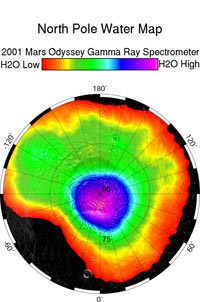
Basically, the Phoenix spacecraft is a lander, that will land on Mars and, using its onboard instruments, conduct research on the surface of the planet. It will look for environments suitable for microbial life and, in that process, learn more about the history of water on Mars. Since Mars
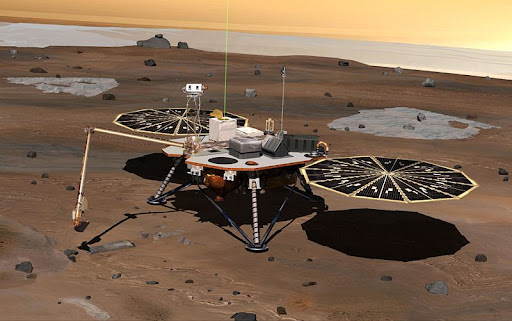
has no liquid water, Phoenix is landing in the arctic region of Mars. In 2002, the Mars Odyssey Orbiter showed a high amount of subsurface water in the Arctic plains (image at left). The lander will, with its robotic arm dig through the protective top soil layer (image at right), reaching its way into the
water below. After digging,
the lander will then bring in the soil and the water onboard on to the lander platform, where scientific instruments will analyze the samples.

The name Phoenix comes from the fact that the Phoenix program is very similar to the mythological namesake, which is a bird that is reborn from its ashes after it burns and dies. Many of the spacecraft's parts come from pervious projects. For example, the lander that the spacecraft is using has been modified from the Mars Surveyor 2001 lander.

Images from JPL, LPL, NASA.

April 1, 2008

Virgle


Virgle is an April Fool's Joke from Google, like previous ones that they have made, like Google Gulp and Google TiSP. It proposes a "Plan B," carried out over a hundred years, that will aim to colonize the red planet, Mars, by Virgin and Google teaming up. You can even fill out an application to become a "pioneer" in this endeavor, and watch video messages by Larry Page and Sergey Brin, cofounders of Google, and Richard Branson of Virgin. However, it is just an April Fool's joke. But Google points out in one of the pages on the Virgle website, "Virgle isn't real. Yet."

The information on Virgle's website are mostly all based on facts. In fact, if you read the FAQ on the website, you can learn a lot about Mars, terraformation, etc. As Google suggests on an obscure web page stating that Virgle is not real yet, all of this can become reality in the future. Terraforming, as Wikipedia explains, is the process that can make a planet or any other body in space have a similar environment to that of the Earth, to make it habitable for humans. This process is possible and may even take place in the near future. Also, Google suggested a self sustainable base on Mars. This too is also a viable possibility, that may take place as humans look to expand their horizons and settle out of Earth.

So, you can get a good laugh by going to Virgle, but keep in mind, all of this may be reality in the future.

Image from Google.com

The video messages of Larry Page, Sergey Brin, and Richard Branson are posted below:


January 14, 2007

Help Find Life!

SETI@home is project to help the Search for Extraterrestrial Intelligence. To participate, all you have to do is download a free program and SETI@home will use your computer to look through data from radio telescopes.